Investigating the effects and underlying mechanisms of glycosylation sites on the immunogenicity of COVID-19 vaccines Utilizing MMS
Investigation Summary - CFDA - Nature Publication.
Surface glycosylation plays a pivotal role in modulating the structural stability, viral infectivity, and immune evasion tactics of theSARS-CoV-2 spike protein receptor-binding domain (RBD). In this study, researchers from the National Institutes for Food and Drug Control (NIFDC/CFDA)systematically investigated the impact of site-specific glycosylation on the immunogenicity of the RBD-dimer antigen utilized in the ZF2001 vaccine. By generating a series of site-directed, glycosylation-deficient mutants (includingN-N331-NA, N-N343-NA, and O-T323-NA), the team mapped how individual glycan deletions altered both in vitro biophysical properties and in vivo immune responses. The investigation revealed that while certain mutations were tolerated, the N343 glycan site acts as a critical structural hotspot. Deletion of the N343 glycan significantly compromised local conformational stability and disrupted vital antigenic epitopes, leading to a profound reduction in neutralizing antibody titers and compromised T-cell mediated immune responses in animal models.
Benefits of Using Microfluidic Modulation Spectroscopy(MMS)
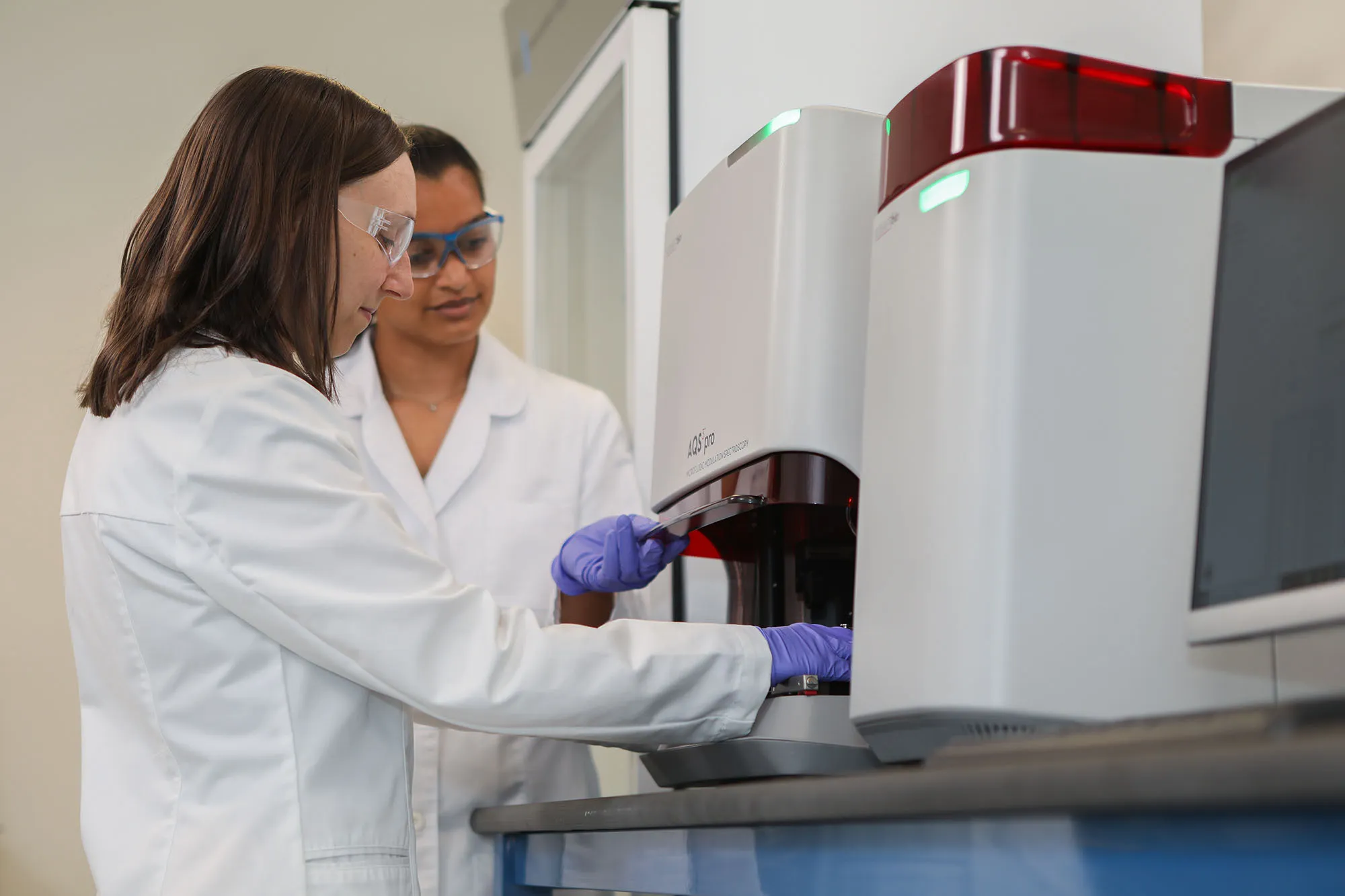
To establish a definitive link between glycan loss and the subsequent decline in vaccine efficacy, the authors deployed RedShiftBio’s AuroraTX instrument utilizing Microfluidic Modulation Spectroscopy (MMS). MMS provided several critical analytical advantages over traditional secondary structure techniques:
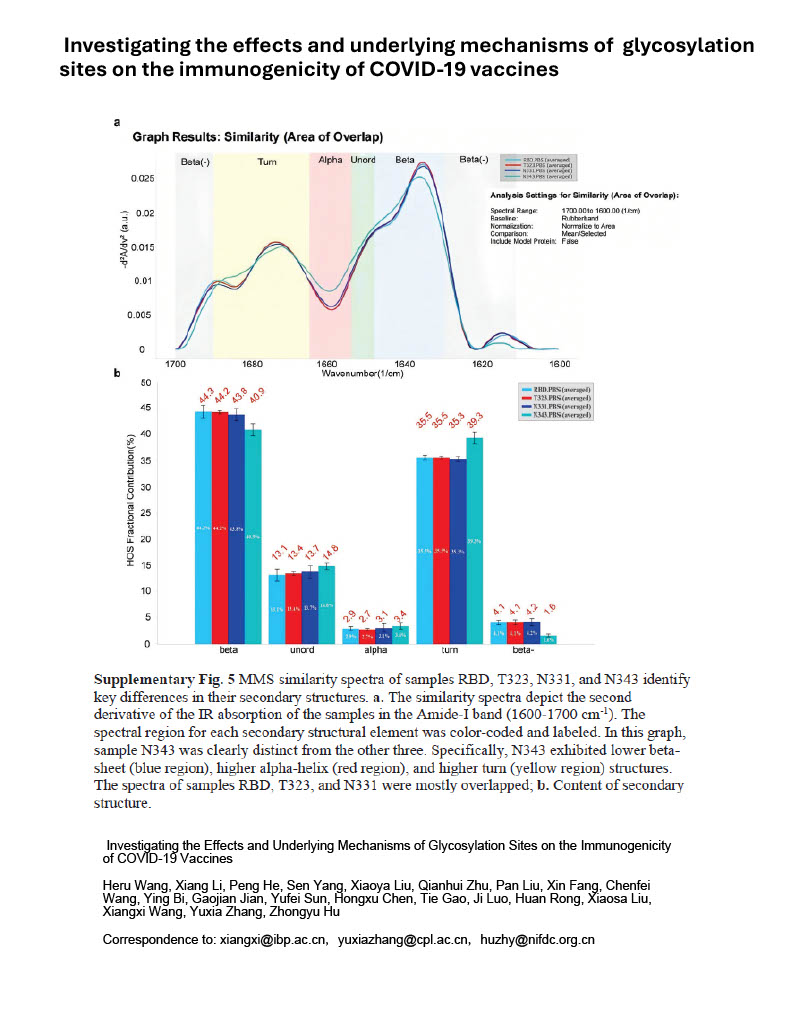
- Ultra-High Sensitivity in the Amide I Band: Because pure glycans do not absorb directly in the Amide I region (1600–1700 cm⁻¹), MMS was uniquely capable of measuring the indirect structural consequences of de glycosylation. The platform tracked minute, localized shifts in the protein backbone’s hydrogen-bonding network, providing definitive physical proof that removing the N343 glycan directly destabilizes nearby $\beta$-sheets and loops.
- Real-Time Background Subtraction: Vaccine antigens often exist in complex formulations or buffers that plague traditional Far-UV Circular Dichroism (CD) or conventional FTIR with high background noise and light scattering. The Aurora’s microfluidic modulation rapidly switched between the sample and the matching buffer, completely eliminating background interference and ensuring unmatched spectral reproducibility.
- De-Risking Vaccine Design with Higher Precision: MMS successfully bridged the gap between raw mass spectrometry data (which mapped the glycan profiles) and in vivo immunology data. By delivering high-resolution, automated secondary structure quantification, MMS allowed the researchers to definitively confirm that the loss of neutralizing efficacy was a direct consequence of structural distortion, proving itself a vital tool for the rational design and quality control of next-generation biotherapeutics and vaccines.
-Investigating the Effects and Underlying Mechanisms of Glycosylation Sites on the Immunogenicity
of COVID-19 Vaccines
Heru Wang, Xiang Li, Peng He, Sen Yang, Xiaoya Liu, Qianhui Zhu, Pan Liu, Xin Fang, Chenfei
Wang, Ying Bi, Gaojian Jian, Yufei Sun, Hongxu Chen, Tie Gao, Ji Luo, Huan Rong, Xiaosa Liu,
Xiangxi Wang, Yuxia Zhang, Zhongyu Hu
Correspondence to: [email protected],[email protected],[email protected]
Enter your Information to Download the Study